
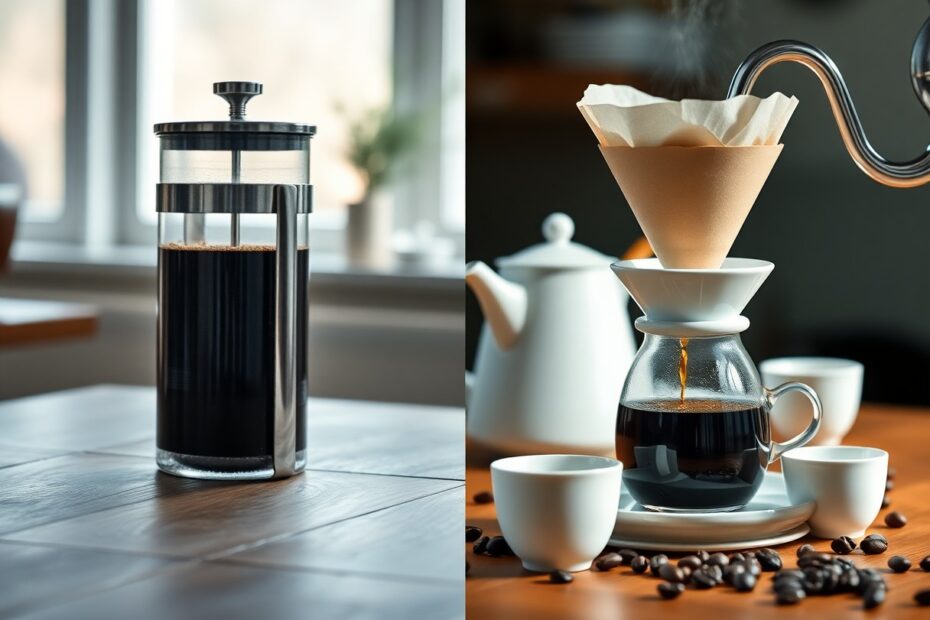
Brewing coffee at home gives you control over flavor, body, and clarity. You decide how rich or clean you want your cup. The French press delivers bold, full-bodied coffee with oils intact, while the pour over offers a brighter, more nuanced profile. Your preference shapes which method brews better coffee for you.
The Heavy Steep
French press immersion extracts flavor differently than pour over’s quick drip. You let coffee steep for four full minutes, fully saturating the grounds in hot water. This extended contact time pulls out deeper notes-chocolate, earth, and spice-often muted in lighter brews. The metal mesh filter doesn’t block oils or fine particles, so what ends up in your cup is rich and full-bodied.
Water temperature and grind size play a bigger role here than you might expect. Too fine a grind and your coffee turns muddy; too coarse and it tastes weak. The French press demands attention to detail, rewarding patience with intensity. You’re not just brewing coffee-you’re coaxing flavor from every particle.
Unlike paper-filtered methods, this method preserves the coffee’s natural texture. You feel the weight of the brew on your tongue, almost syrupy in consistency. It’s not subtle, and it doesn’t aim to be. For those who want boldness over brightness, the French press delivers.
The weight of the oils
Oils in coffee carry flavor compounds that paper filters strip away. When you use a French press, those oils remain suspended in your cup, contributing to a heavier mouthfeel. You notice it immediately-the slickness on your lips, the lingering finish. This isn’t a flaw; it’s the essence of immersion brewing.
Pour over methods remove most oils with paper filters, resulting in a cleaner, crisper taste. But that clarity comes at a cost. You lose some of the coffee’s depth, especially in darker roasts where oils are more abundant. The French press embraces those oils, letting them shape the experience.
Your preference for oil content defines your ideal brew. If you enjoy a rounded, almost chewy texture, the French press satisfies. If you favor clarity and brightness, pour over wins. Neither is wrong-just different expressions of the same bean.
The silt in the glass
Sediment is an unavoidable part of French press brewing. Even with careful pouring, fine coffee particles settle at the bottom of your cup. You’ll feel them between your teeth if you drink too quickly. This silt isn’t a sign of poor technique-it’s proof of full extraction.
Pour over systems trap these fines in paper filters, delivering a grit-free experience. The trade-off is a lighter body and less complexity. With French press, you accept the silt as part of the ritual. It’s a small price for the depth it brings.
You learn to leave the last sip behind, respecting the layer of sediment. It’s not waste-it’s the concentrated essence of the brew. Some see it as messy; others, as a mark of authenticity.
That final spoonful of sludge holds concentrated oils and micro-grounds, packed with flavor. While most discard it, stirring it in occasionally reveals a bolder, more intense finish. It’s not for everyone, but for those who appreciate full extraction, it’s part of the experience.
The Simple Machine
Every morning, your ritual begins with a quiet decision: which device will shape your coffee experience today? The French press and pour over may seem like humble tools, but each is a study in mechanical simplicity and brewing philosophy. One relies on immersion, the other on precision flow, yet both demand your attention and respect.
There’s a tactile honesty in using either method-no hidden electronics, no automated timers. You control the water temperature, the grind size, the steep time. This direct involvement transforms brewing from a chore into a mindful act, where small adjustments yield noticeable differences in flavor.
Despite their minimalist designs, these brewers reveal complexity in practice. The French press extracts bold, full-bodied coffee by steeping grounds entirely. The pour over emphasizes clarity and brightness through controlled drip. Your preference depends not just on taste, but on how you want to engage with the process.
Steel and glass
Stainless steel and heat-resistant glass define the look and function of most French presses. The carafe holds the brew, while the metal frame supports the plunger and filter assembly. These materials work together to maintain temperature and withstand daily use.
Thick glass retains heat well, helping the coffee steep evenly, but it can be fragile if mishandled. Stainless steel versions are more durable and better at insulation, often preferred for outdoor use or busy kitchens. Your choice affects both longevity and brewing consistency.
The mesh filter, usually made of fine stainless steel, allows oils and fine particles to pass through. This contributes to the rich mouthfeel French press coffee is known for. Unlike paper filters, it doesn’t strip away the coffee’s natural lipids, preserving more of the bean’s character.
The steady plunger
Pressing down the plunger is the defining moment of the French press method. A slow, even motion separates the brewed coffee from the spent grounds. This action requires patience-rushing it stirs up sediment and leads to a gritty cup.
The plunger’s filter plate must sit flush against the carafe walls to work effectively. Any gap allows grounds to escape, undermining the clean separation you’re aiming for. Over time, wear on the seal or mesh can affect performance, so regular inspection matters.
When done correctly, the plunger delivers a full, rich brew in about four minutes. It’s a physical interaction that connects you to the process in a way automated systems never can. The resistance you feel is part of the rhythm, a tactile cue that brewing is complete.
What makes the plunger truly effective is its simplicity-no moving parts, no complexity, just a well-designed seal and consistent pressure. It doesn’t force the coffee through a filter; it gently displaces the liquid, leaving most of the grounds behind. This method preserves body and depth, giving you a cup that feels substantial and complete. Over time, you’ll learn the exact pace that works for your grind and brew time, making each press a small act of refinement.
The Focused Hand
Control defines your pour-over experience more than any other factor. Your hands guide the water with precision, shaping extraction drop by drop. Unlike automated methods, this technique demands presence-each motion influences flavor, clarity, and balance in your cup.
Water flows differently depending on how steadily you pour. A shaky hand disrupts the bed of grounds, creating channels where water rushes through too fast. Consistency in speed and height ensures even saturation, unlocking sweetness and acidity in harmony.
You’re not just brewing coffee-you’re directing a process. The rhythm of your wrist, the angle of your kettle, the timing of each pass-all contribute to the final result. Mastery comes not from speed, but from mindful repetition and attention to detail.
The swan neck kettle
A swan neck kettle gives you command over water placement like no other tool. Its slender, curved spout allows you to direct a thin, steady stream exactly where it’s needed. This level of control is non-negotiable for even extraction.
Standard kettles pour too broadly, dousing grounds unevenly and risking over-extraction in some spots and under-extraction in others. With a swan neck, you maintain a tight spiral, saturating each layer of coffee with purpose and care.
Heat retention matters just as much as design. High-quality models hold temperature steady throughout the brew, preventing sudden drops that mute flavor. Your kettle isn’t just a vessel-it’s an extension of your technique.
The circle of the pour
A consistent spiral pour starts at the center and moves outward in tight, deliberate circles. This motion prevents channeling and ensures every coffee particle interacts with water at the same rate. Your wrist guides the pattern, not randomness.
Begin with a bloom-pour just enough water to wet all grounds evenly. Wait 30 to 45 seconds as gases escape. Then resume the spiral, maintaining a steady flow that keeps the bed uniformly saturated without disturbing it.
Over-pouring to the outer rim can cause water to bypass the coffee bed, leading to weak, papery results. Staying within the inner two-thirds of the bed maximizes contact time and improves clarity.
Perfecting the circle of the pour takes practice, but the payoff is immediate in the cup. A well-executed spiral brings out layered notes-floral highs, fruity midtones, and a clean finish-without bitterness or imbalance. Your pour shapes the flavor profile more than you might think.
The Truth of the Bean
Every coffee bean carries a story shaped by altitude, soil, and climate, and how you brew it determines which parts of that story get told. The method you choose doesn’t just extract flavor-it reveals character. French press immersion pulls out deep, earthy tones, often highlighting the body and richness inherent in darker roasts. You taste the bean’s foundation, unfiltered and bold, with oils and fine particles contributing to a heavier mouthfeel. This isn’t about clarity; it’s about presence.
Pour over, in contrast, strips away the noise. Water passes cleanly through a paper filter, capturing sediment and most oils, leaving behind a crisp, articulate cup. You hear the high notes-the floral hints in an Ethiopian Yirgacheffe, the citrus spark in a Kenyan AA. This method respects nuance, rewarding careful pouring and precise timing. Your palate detects subtleties that immersion might drown.
Neither approach is truer to the bean-they simply emphasize different truths. One celebrates depth and texture; the other, brightness and detail. Your preference says as much about you as it does about the coffee.
The dark immersion
French press brewing wraps your coffee in hot water and lets it steep, like a slow conversation between metal and bean. This full immersion extracts compounds over four minutes, pulling out soluble oils and fine sediments that give the drink its signature weight. You feel the coffee as much as taste it-thick, warm, and enveloping. The metal mesh filter allows more particulate matter through, contributing to a bolder, more rustic profile.
Dark roasts thrive here, their smoky, chocolatey, or nutty tones amplified by the method’s forgiving nature. Even if your grind is slightly off, the press delivers a satisfying cup. There’s a comfort in its simplicity-coarse grind, hot water, plunge. No special gear, no precise pouring technique required.
You’re not chasing elegance with a French press. You’re after substance, a cup that lingers on the tongue and warms you from within. It’s coffee as ritual, not performance.
The bright acidity
Pour over highlights the lively, tea-like qualities hidden in light to medium roasts. As water spirals through the grounds in controlled pulses, it extracts delicate acids and aromatic compounds often lost in immersion. You taste the zing of lemon in a Guatemalan, the berry-like pop of a Rwandan. This method rewards attention-your pour speed, water temperature, and bloom time all shape the final cup.
A paper filter traps oils and fines, producing a clean, transparent brew. Without the weight of sediment, flavors emerge with precision. Each sip feels crisp, almost ethereal, letting floral and fruity notes shine. It’s not about power; it’s about clarity and expression.
When you want to hear every note the bean can sing, pour over becomes your instrument. The method doesn’t mask flaws, but it also doesn’t hide brilliance. You taste the farm, the harvest, the roast-layer by layer.
Acidity in pour over isn’t sharpness for its own sake-it’s balance. A well-executed brew uses that brightness to lift the sweetness, creating a dynamic cup that evolves as it cools. You notice new flavors with each sip, a complexity that invites slow sipping and quiet reflection. This is coffee as revelation, not routine.
Conclusion
Now you understand the core differences between French press and pour over brewing. The French press delivers a full-bodied, rich cup with noticeable sediment and a more oily mouthfeel, thanks to its metal mesh filter and immersion method. You experience bold flavors and a heavier texture, ideal if you enjoy coffee with depth and intensity.
Pour over, in contrast, produces a cleaner, brighter cup. The paper filter removes oils and fines, highlighting clarity and nuanced notes, especially in light to medium roast beans. Your control over water flow and timing allows precision, making it a favorite among those who appreciate consistency and subtlety in flavor.
Your preference ultimately shapes which method brews better coffee for you. If you favor richness and simplicity, the French press suits you. If you seek clarity and complexity, pour over is the better choice. Both methods offer distinct experiences-neither is objectively superior, but each reflects your taste and brewing priorities.